


DJI FLYCART 100
Achieve More Deliveries
DJI FC100 |Dual Battery| Flagship Winch System| Integrated Parachute
From $23,642 CAD
Introducing the brand new DJI FC100, 85 kg[1]payload capacity with dual battery, 2 payload systems, integrated seamlessly with a powerful developer ecosystem, redefine professional delivery and break through the operational boundaries. The intelligent and advanced Safety System enables unstoppable delivery from mountains to oceans, unlocking infinite possibilities.
85 kg Max Payload Capacity
with Dual Battery
Max Flight Distance
Flagship Winch System
LiDAR + Penta-Vision System +
Millimeter-Wave Radar
Ultra-Fast Charging
Brand New One-Stop Software Solution
Flight Performance
Greater Load, Superior
Performance
Carry heavier and reach farther, expertly balances excellent performance with power efficiency. Experience efficient delivery.
85 Kg
Max Payload
with Dual Battery[1]
12 Km
Max Flight Distance with 149.9 kg
Takeoff Weight[2]
82 kg
Max Single-Axis Thrust
32 %
Enhanced Power Efficiency[3]
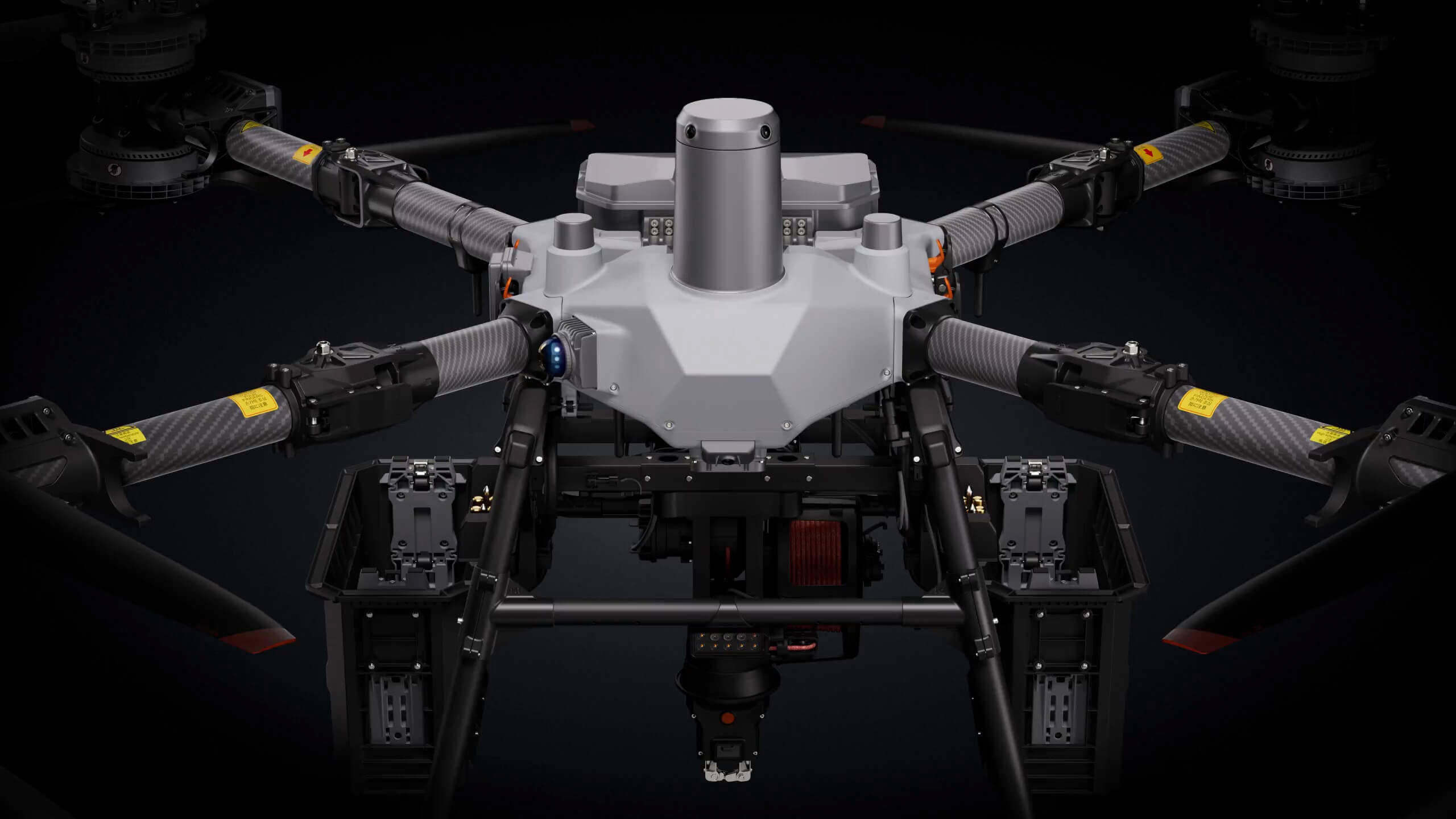
100 kg Max Payload with Single Battery[1]
85 kg Max Payload with Dual Batteries[1]
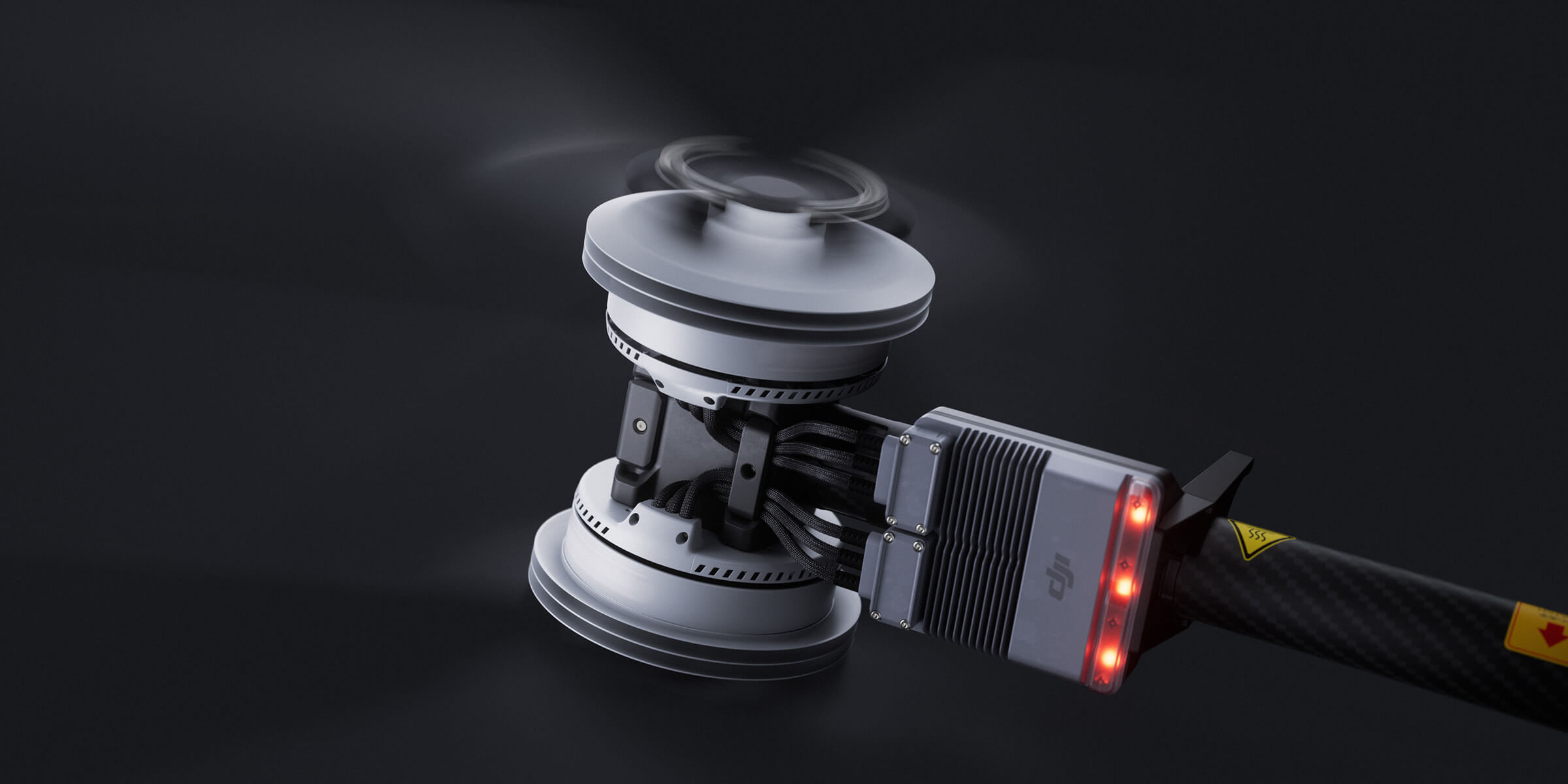
Compact size, high load capacity. Powerful propulsion system offers enhanced safety redundancy, featuring Propeller Stop Protection for added security and reliability.
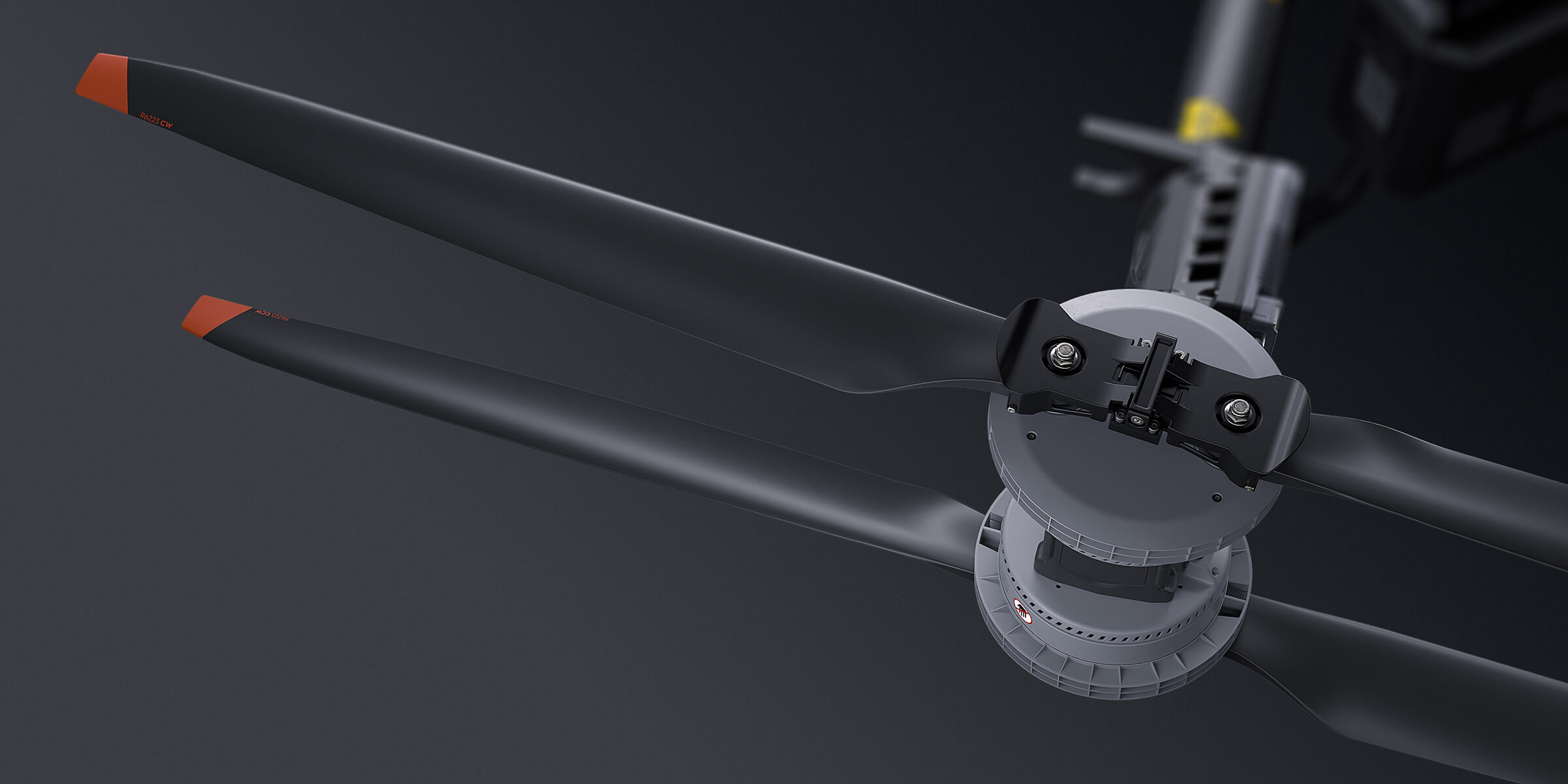
Carbon fiber propellers offer greater rigidity and lighter weight, can resist deformation even at high temperatures. With Optimized airfoil and enlarged propeller diameter, energy efficiency is improved. The upper motors are equipped with Propeller Clamps, which reduce propeller vibration for more stable flight.
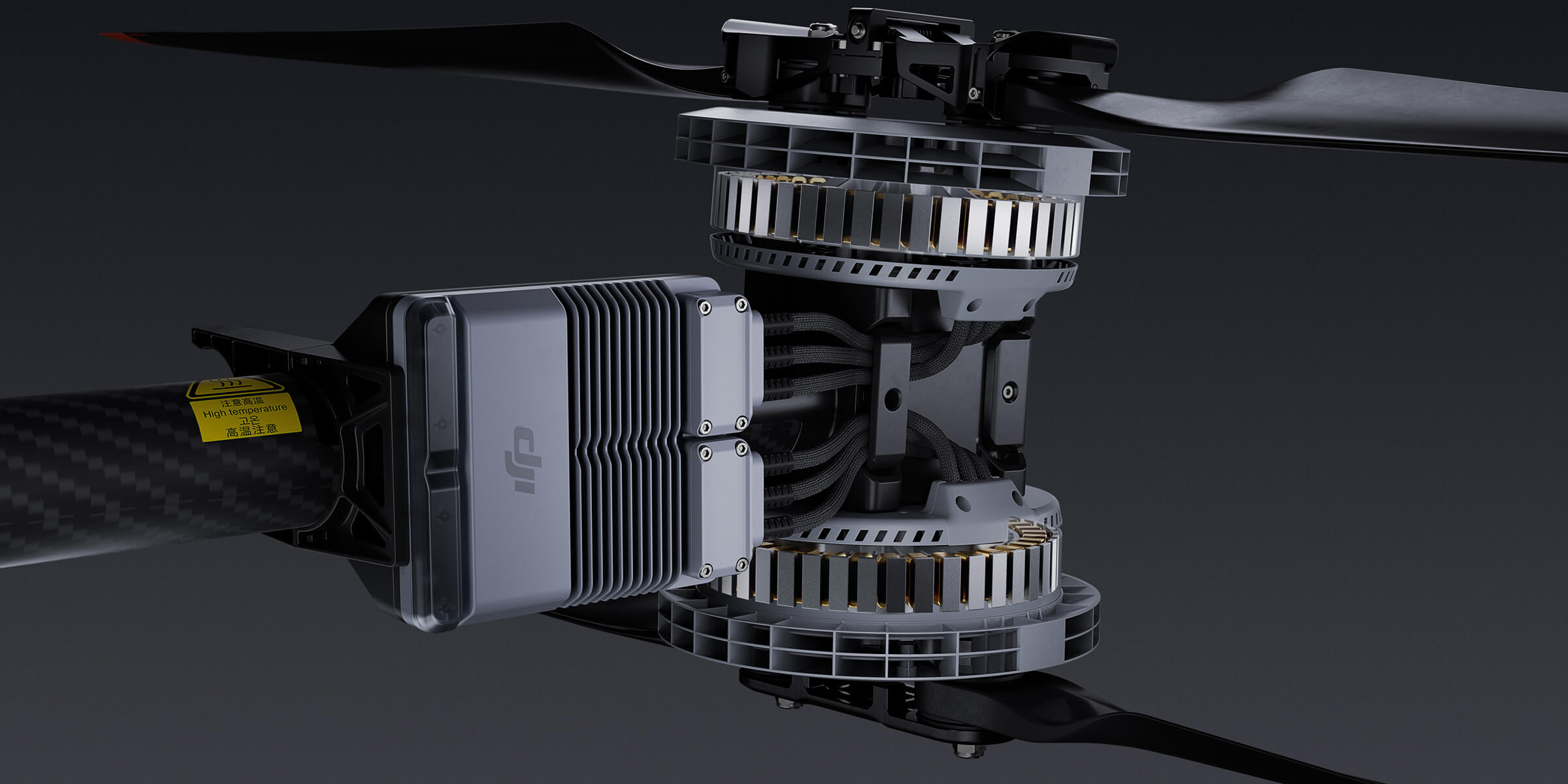
Larger motors, more torque. ESC with 420A current ensure stable and reliable operation, providing faster response times.
Payload System
Intelligent Deliver Control
Ultra-fast Response
FC100 supports 2 payload systems, the brand new Flagship Winch System, equipped with an Electric Hook for efficient loading and unloading. Also compatible with DJI Dual-Battery Lifting System, flexibly adapting to various delivery scenes.
DJI FlyCart 100
Flagship Winch System
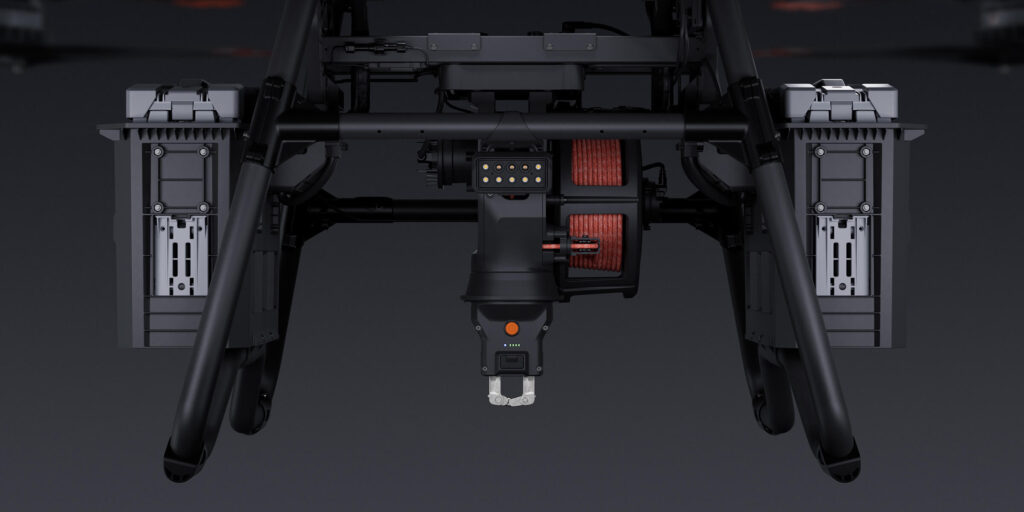
Electric
Hook
Electric Opening and Closing[4]
Wireless
Charging[5]
Convenient and Hassle-Free
Real-Time
Weighing
Avoid Overloading, Convenient for Settlement
Audible and
Visual Alerts
Safe Loading and Unloading
DJI Dual-Battery Lifting System
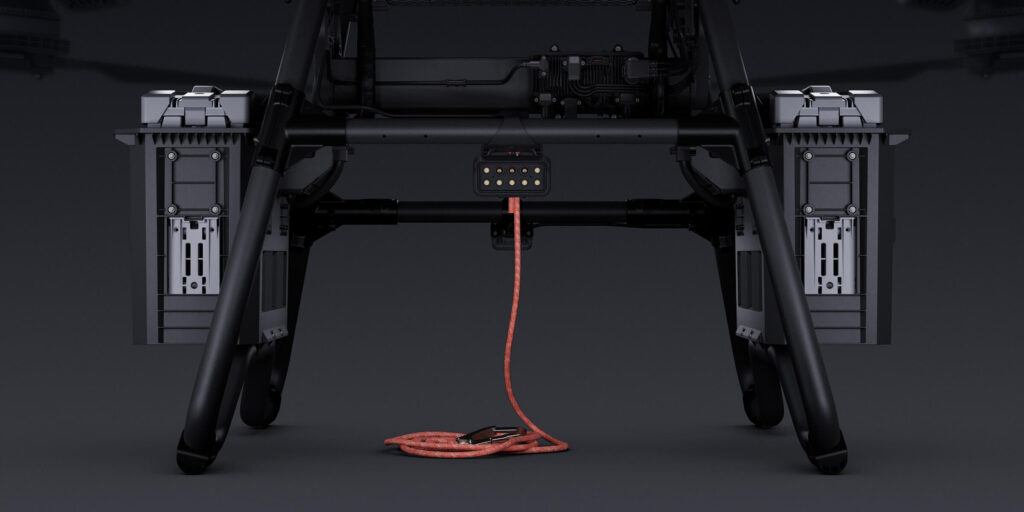
Auto Balance Control
Minimize swing with a single click for smooth delivery
Rope Cut Escape
Heat and melt the rope with one click to free the drone for safe disentanglement
Real-Time Weighing
Avoid overloading, convenient for settlement
Safety System
Deliver with Ease in
Complex Environments
DJI FC100 Intelligent Safety System, equipped with new LiDAR, Millimeter-Wave Radar[6], and Penta-Vision System. These features enable comprehensive environment awareness, allowing for precise obstable detection[7].
Application Scenarios
Emergency
Fast response, assisting with emergency rescue supplies transport.
Firefighting
Efficient deployment, ensuring flexible transport of firefighting equipments.
Utility
Payload capacity significantly increased, transport more utility tools and equipments.
Construction
Overcome terrain limitations, ensuring safe and efficient contstruction tools transport.
Logistics
Empower logistics scenarios, usher in a new era of low-altitude economy.
Waters
Reduce supply transportation costs and ensure efficient transport over waters.
Get In Touch
Have a question? Ready for a quote?
We’re here to help! Reach out to us today.
Specs
Weight (without payload)
55.2 kg (with Lifting System)
60.2 kg (with Winch System)
Excludes the weight of the battery, dual-battery compartment, accessories, cable, and hook.
Max Takeoff Weight
170 kg
This is the performance specification of the drone. Follow local laws and regulations.
Max Diagonal Wheelbase (motor to motor)
2330 mm
Diagonal Length (tip to tip)
3904 mm
Dimensions (arms & propellers unfolded)
3220 mm × 3224 mm × 975 mm
Overall Dimensions (arms folded, propellers unfolded)
1820 mm × 1840 mm × 975 mm
Overall Dimensions (arms & propellers folded)
1105 mm × 1265 mm × 975 mm
Folding Method
Towards body
Loadable Battery Quantity
Supports dual-battery and single-battery configurations
Single-battery mode is for emergency use.
Max Flight Distance
Under 149.9 kg takeoff weight:
• Dual battery: 12 km
• Single battery: 6 km
Measured with a fully charged new battery at 149.9 kg takeoff weight, optimal constant speed, 0% remaining charge, windless conditions, 25°C, sea level. Results vary based on environment, use, and firmware.
Max Hovering Endurance
Under 149.9 kg takeoff weight:
• Dual battery: 12 minutes
• Single battery: 6 minutes
Measured hovering to 0% charge under the same conditions as above.
Max Flight Time
Under 149.9 kg takeoff weight:
• Dual battery: 14 minutes
• Single battery: 7 minutes
Measured flying at optimal constant speed to 0% charge under the same conditions as above.
Operating Temperature
-20°C to 40°C
Tested at approx. 960 W/m² solar radiation. Long-term high-temperature exposure may shorten component lifespan.
Ingress Protection Rating
IP55
Rating may decrease with wear and aging. Propulsion system not covered. After flying in rain, idle the drone for 1 minute to reduce corrosion risk (based on precipitation >24.9 mm/24h).
Hovering Accuracy (with strong GNSS)
RTK enabled: ±10 cm horizontal, ±10 cm vertical
RTK disabled: ±60 cm horizontal, ±30 cm vertical
RTK/GNSS Operating Frequency
GPS + Galileo + BeiDou + GLONASS
Max Ascent Speed
5 m/s
Measured in dual-battery mode at sea level, 25°C, no wind.
Max Descent Speed
5 m/s
Measured in dual-battery mode at sea level, 25°C, no wind.
Max Horizontal Speed
20 m/s
Measured in dual-battery mode at sea level, 25°C, no wind.
Max Flight Altitude (above sea level)
6000 m
Payload capacity decreases with takeoff altitude. 6000 m is the maximum safe altitude with two batteries and no payload (assuming takeoff at 4500 m).
Maximum Flight Altitude (relative to takeoff point)
1500 m
Flight altitude is constrained by takeoff altitude; total maximum for this aircraft is 6000 m above sea level.
Max Wind Speed Resistance
12 m/s
Maximum wind resistance during takeoff and landing.
Stator Size
155 × 16 mm
Motor KV Value
60 rpm/V
Propeller Material
Carbon fiber composite
Propeller Dimensions
62 inches (1574.8 mm)
Propeller Type
Dual-blade folded propeller
Number of Rotors
8 pairs
Safety System Type
Front millimeter-wave radar
Rear radar (single board)
Downward radar (single board)
LiDAR
Quad-vision system
FPV
Millimeter-Wave Radar EIRP
<20 dBm (NCC/MIC/KC/CE/FCC)
Operating Temperature
-20° to 40° C (-4° to 104° F)
Operating Environment Requirements
Adequate light and discernible surroundings
Operating Power Consumption
LiDAR: 6.5 W
Front radar: 18 W
Downward radar: 5 W
Rear radar: 5 W
Field of View (FOV)
LiDAR: Vertical 272°, Horizontal 60°
Front radar: Horizontal 360°, Vertical ±45°
Downward radar: Left/Right ±12.5°, Front/Back ±22.5°
Rear radar: Left/Right ±45°, Front/Back ±45°
Quad-vision system: Horizontal 360°, Vertical 180°
FPV camera: Horizontal ±86°, Vertical 108°
Measurement Range
≤ 60 m
Notes
The effective sensing range and its ability to avoid and bypass obstacles vary depending on ambient light, rain, fog, and the material, position, shape, and other properties of obstacles. Downward sensing assists in Terrain Following and altitude stabilization, while other directions assist with obstacle avoidance. AR safety assistance features serve only as supplementary hints; operators must confirm the surrounding environment’s safety during operation.
Downward sensing assists in Terrain Following flight. If the bottom collides with obstacles, it is considered user responsibility.
Due to limitations in safety system performance, the aircraft cannot automatically avoid moving objects; accidents of this nature are attributed to user responsibility.
Cargo obstacle avoidance is only auxiliary; if the cargo or lifting cable collides with an obstacle, it is the customer’s responsibility.
Max Transmission Distance
20 km (FCC)
10 km (CE)
12 km (SRRC)
10 km (MIC)
Measured in an unobstructed environment free of interference. The above data represents the farthest communication range for one-way, non-return flights under each standard. During your flight, please follow reminders in the DJI Delivery App.
Operating Frequency
2.400 GHz to 2.4835 GHz
5.725 GHz to 5.850 GHz
The supported operating frequency bands and available ranges vary by country/region. Refer to local laws and regulations.
Transmitter Power (EIRP)
2.4 GHz: <33 dBm (FCC), <20 dBm (CE/SRRC/MIC)
5.8 GHz: <33 dBm (FCC), <30 dBm (SRRC), <14 dBm (CE)
Live View Quality
1080p/30fps
Antenna
4 antennas, 2T4R
4G Enhanced Transmission
Supported
Illumination Direction
Forward, Downward
Control Mode
Auto, Manual
Max Illumination Power
46 W (Standard)
Model
E2MSF-100A
Touchdown Speed
≤ 7 m/s
Measured at sea level, 25°C, windless conditions, aircraft at maximum takeoff weight, parachute open at 100 m height.
Parachute Shape
Square
Material
Nylon
Minimum Opening Height
100 m
Ensures the aircraft reaches a stable velocity upon ground contact.
Operating Temperature
-20° to 40° C (-4° to 104° F)
Ingress Protection Rating
IP55
Mainboard Power-off Battery Life
≥ 1 hour
Memory Card Capacity
Independent storage; real-time recording of each flight; capable of recording 10 flights.
Alarm Method
Buzzer alarm and lighting alarm
Opening Method
Manual opening, Auto opening
Model
A2EWH-100A
Dimension
960 mm × 805 mm × 669 mm
Hook Charge Method
Wireless charge, Type-C charge
Wireless charge requires the hook to be fully tightened.
Hook Supply Power Time
10 hours
Measured in ideal windless conditions at sea level, 25°C. Results may vary depending on environment, usage patterns, and firmware. Refer to app prompts during use.
Cable Length
0–30 meters
Max Retraction Speed
1.2 m/s
Weighing Function
Supported
Hook Opening and Closing Function
Supports active control via app or button
Emergency Escape Mode
Cable Discard Escape
Auto Balance Control
Supported
Manual Wheel Control for Retraction
Supported
One-Tap Release and Retraction
Supported
Intelligent Deceleration Protection
Supported
Model
A2EDL-100A
Dimensions
960 mm × 805 mm × 669 mm
Cable Length
10 meters
Emergency Escape Mode
Cable Cut Escape
Auto Balance Control
Supported
Weighing Function
Supported
Recommended Cable Length
10–15 meters
Weight
14.7 kilograms
Capacity
41 Ah
Standard Voltage
52 V
Model
TKPL 2
App
DJI Delivery App
Screen
7-inch LCD touchscreen; Resolution: 1920 × 1200; LIGHTEN: 1,400 cd/m²
Charging Environment Temperature
5° to 40° C (41° to 104° F)
Built-in Battery Life
3.8 hours
External Battery Life
3.2 hours
Charging Method
Use a USB-C fast charging charger with a minimum power of 65 W (maximum voltage 20 V). A DJI portable charger is recommended.
Charging Time
2 hours with built-in battery
2.5 hours with built-in and external battery (shutdown status according to official charging method)
4G Enhanced Transmission
Supported
RTK High-Precision Positioning System Module
Supported
Operating Temperature
-20° to 50° C (-4° to 122° F)
Dual Operator Mode
Supported
The second remote controller needs to be purchased separately.
PSDK Communication Interface
Eport-Lite
When connecting a third-party payload externally, an additional DJI FC100 PSDK Connection Cable Combo is required.
PSDK Power Interface
Supports 3000 W
When connecting a third-party payload externally, an additional DJI FC100 PSDK Connection Cable Combo is required.
Charger Model
CSX901-12000
Dimensions
456 mm × 291 mm × 107 mm
Weight
13.13 kg
Input Voltage
Three-phase AC input: 175–520 V
Single-phase AC input: 200–264 V
Output Voltage
62 V
Rated Output Current
194 A
Rated Power
12,000 W (three-phase 380 V input)
3,000 W (single-phase 220 V input)
Actual output may vary due to local power grid conditions, distance, cable material, and wire gauge.
Charging Time
9 minutes
Time to recharge from 30% to 95% battery at sea level, environmental temperature 15°–40°C. Fast recharge supported when battery cell temperature is 15°–75°C. Actual charging time may vary depending on input power, altitude, and initial charge level.
Protection Functions
Over-temperature, over-voltage, under-voltage, short-circuit, fan stall, and other protections
Operating Temperature
0° to 40° C (32° to 104° F)
Output Channels
1
Dimensions
Diameter: 163 × 89 mm (without OcuSync directional antennas)
Weight
Approximately 1.26 kg
Operating Frequency
Relay Station Mode: 2.4 GHz / 5.2 GHz / 5.8 GHz
Base Station Mode: 2.4 GHz / 5.8 GHz
Relay Station Range Enhancement
Performance improvement:
Severe obstructions (e.g., buildings, mountains): 3–5× improvement
Minor obstructions (e.g., trees, glass): 1–3× improvement
The relay station should be deployed in a high, unobstructed location free from interference.
Built-in Battery Operating Time (at room temperature)
D-RTK 3 Multifunctional Station:
Relay Station: 4 hours
Base Station: 7 hours
At low temperatures, range performance may decrease. It is recommended to use a power supply that supports the USB PD3.0 protocol for charging.
Ingress Protection Rating
D-RTK 3 Multifunctional Station: IP67
Ensure all rubber plug interfaces on the body are properly mounted.
Positioning Accuracy
Base Station Mode and Relay Station Mode
Base Station Positioning Error
Single Point Accuracy (Uncalibrated):
Horizontal: 1.5 m (RMS)
Vertical: 3.0 m (RMS)
Satellite-based Differential Accuracy:
Convergence Time: 20 min
Horizontal: 30 cm (RMS)
Vertical: 40 cm (RMS)
Measurement accuracy depends on various factors. Values obtained under normal conditions with unobstructed view, good satellite distribution, low ionospheric activity, and no electromagnetic interference or multipath effects.
Operating Temperature
-20° to 40° C (-4° to 104° F)